
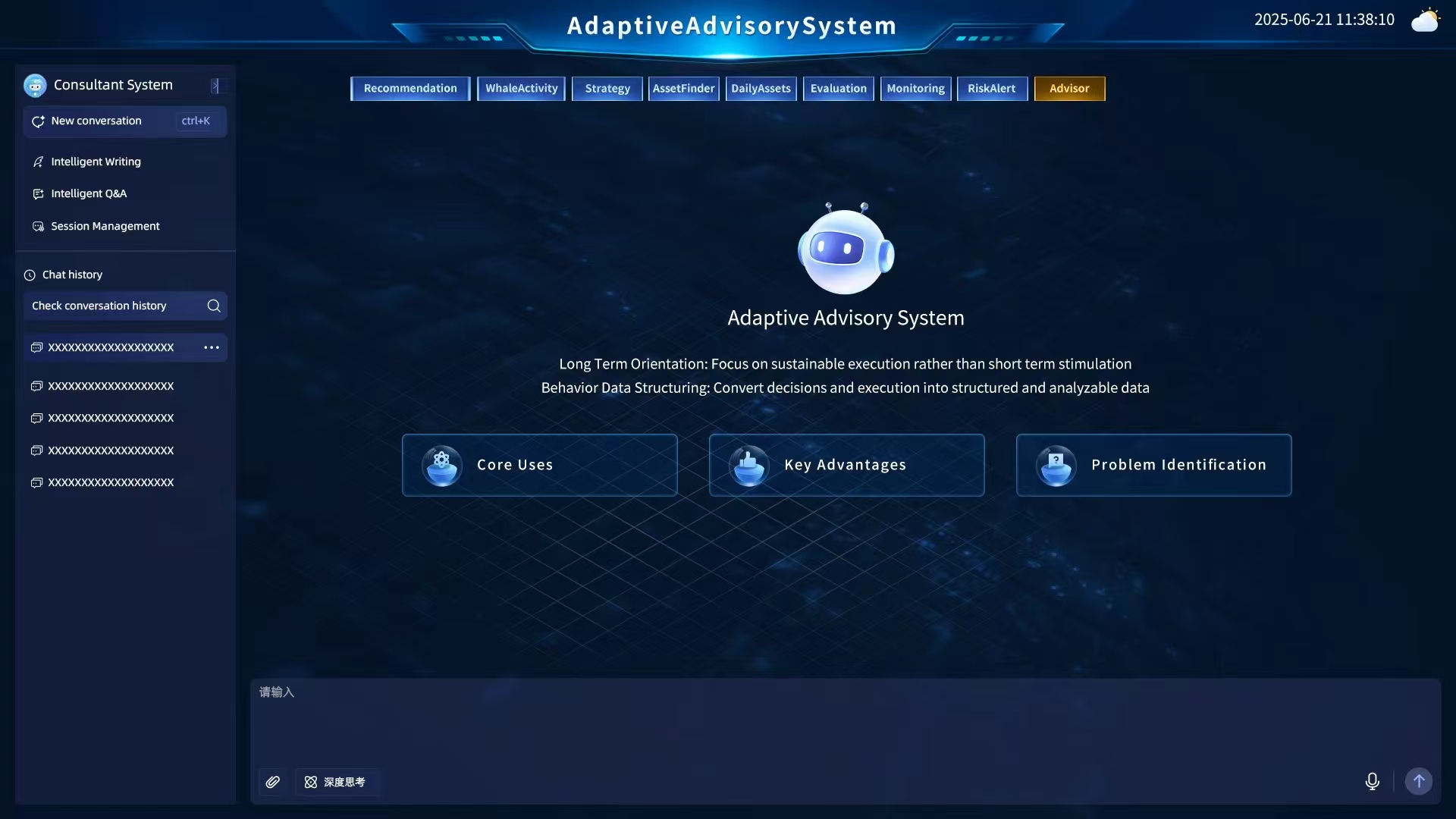
System 9: Legacy Advisor System – A Legacy of Family Investment Wisdom Through Personalized Trading Models
Content Overview:
The Legacy Advisor System is designed to build a sustainable and resilient long-term compounding framework. It not only helps investors improve their trading habits, but also aims to create an intelligent investment platform that can evolve over time and be passed down across generations.
Through advanced learning models and data analysis, the system tracks investor trading behavior and market dynamics in detail.
Based on this analysis, it develops personalized trading models that provide scientific and precise decision support. At the same time, the system continuously improves itself by analyzing historical experience and refining strategies so they remain well aligned with changing market conditions.
More importantly, the Legacy Advisor System can also serve as a platform for family wealth management and knowledge continuity. It records the experience and strategies of multiple generations of investors, preserving valuable insights and decision frameworks.
This allows future generations to benefit from accumulated wisdom and provides them with meaningful guidance as they make their own investment decisions.
Core Purpose:
The Legacy Advisor System records and analyzes investor behavior over time in order to accurately identify individual trading characteristics.
Through this long-term analysis, the system provides detailed behavioral insights that help investors better understand their decision patterns and potential weaknesses.
By examining these patterns closely, the system identifies how investors make decisions and highlights areas that may require improvement, providing a stronger analytical foundation for trading behavior.
Based on these insights, the system generates practical improvement recommendations. For example, if an investor tends to increase trading activity after achieving profits, the system may recommend more rule based trading discipline.
In periods of high market volatility, the system automatically increases confirmation requirements before a trade is executed, helping prevent emotional decisions.
When the system detects repeated mistakes, it analyzes the sequence of events that led to the error, identifies the conditions that triggered it, and issues early warnings if similar conditions appear again. This helps investors avoid repeating the same mistakes.
To support continuous improvement in decision-making, the system provides a structured review framework that guides investors through four key steps of analysis.
1. Review the original reasoning behind the decision, including the market environment and analytical logic at the time.
2. Review the actions taken and evaluate whether the trade followed the original plan.
3. Analyze the final outcome and compare it with the original expectations in order to identify any differences.
4. Summarize the lessons learned and identify specific areas for improvement.
Through this structured review process, investors move beyond focusing only on profit or loss and gain a deeper understanding of the reasons behind each result. This process supports ongoing improvement in investment strategies and behavior.
In addition, the Legacy Advisor System supports collaboration within families or investment teams by integrating the trading experience and strategies of multiple members into a shared knowledge base.
The system analyzes each member’s trading characteristics individually and provides personalized strategy optimization recommendations based on their style. At the same time, it integrates the experience and best practices of the entire group to develop a unified trading framework.
For example, in a three generation investment team consisting of a father, a son, and a grandson, the system can analyze the father’s experience driven trading style and extract strategies that have proven effective over time.
It can summarize the son’s strengths in quantitative analysis and model development, while identifying the grandson’s capabilities in data analysis and signal recognition. By combining the strengths of all three generations, the system builds a structured and scientific family trading framework.
Through continuous learning and iterative optimization, the Legacy Advisor System ultimately helps families or teams develop a unique and transferable trading model.
This model includes the family’s core investment philosophy, commonly used strategy combinations, unified risk management principles, and a disciplined execution framework. By identifying decision biases and recurring mistakes, the system provides personalized improvement guidance for each member while also passing valuable investment knowledge to the next generation.
This helps prevent future investors from repeating past mistakes. Through collaboration and knowledge sharing, the system supports the development of a unified investment approach that promotes stable long-term wealth growth and the transfer of financial wisdom across generations.
Key Advantages:
The Legacy Advisor System is built around a high level of personalization. Through long-term behavioral analysis, it delivers precise insights and targeted recommendations rather than broad or generic advice. The system also has the ability to evolve continuously by learning from new data over time, which allows its recommendations to become increasingly accurate and effective.
At the same time, the system transforms accumulated investment experience and strategies into a structured framework that can be passed on across generations. This supports the long-term continuity of family wealth management.
The system also emphasizes collaboration by enabling families or investment teams to share knowledge and integrate insights from multiple members. In doing so, it creates a structured and scientific framework for cooperative investment decision-making.