
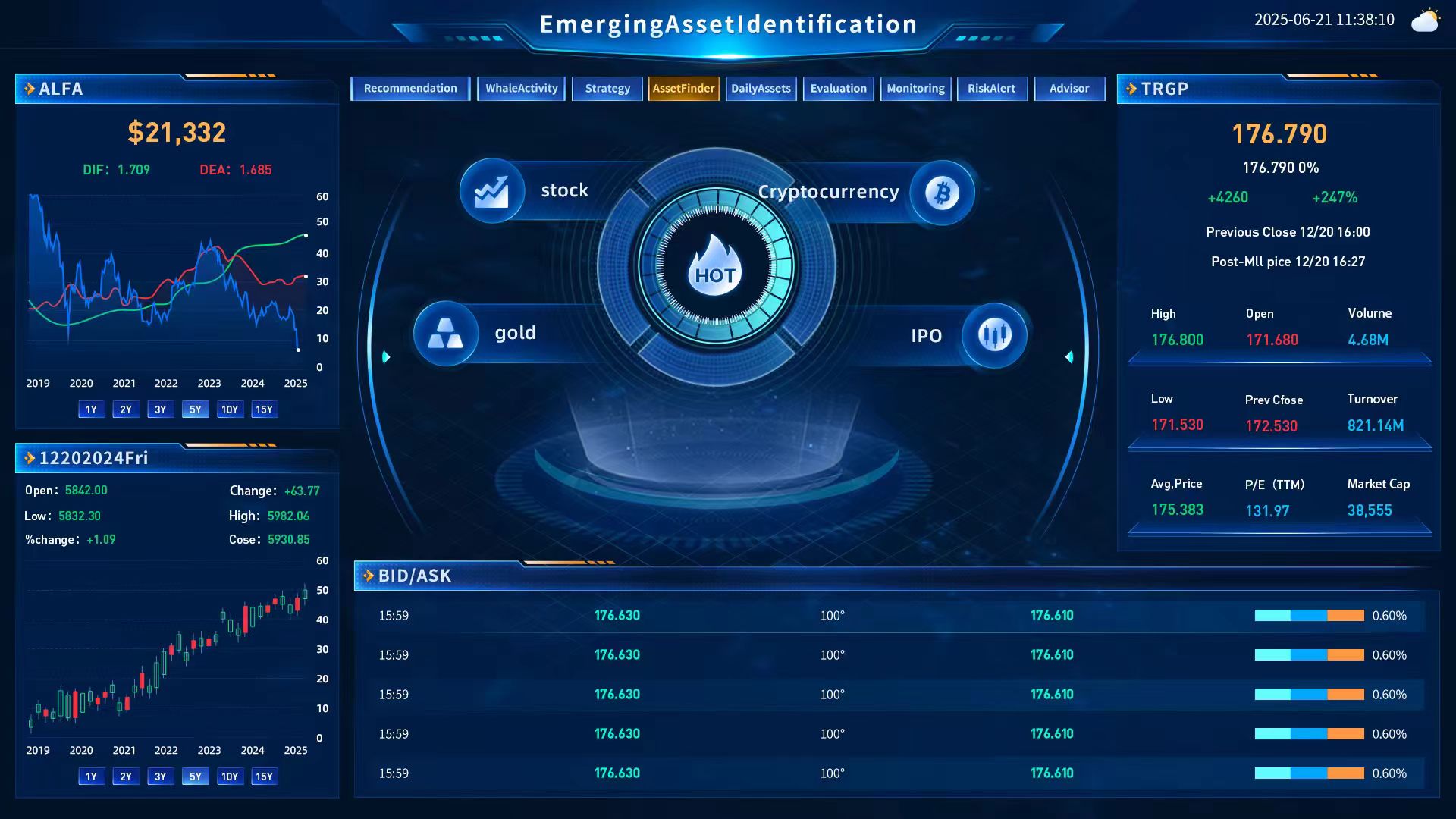
Function 4: Emerging Asset Identification System – Filter Risks First, Then Evaluate Opportunities
Content Overview:
In emerging asset markets such as cryptocurrencies, ICOs, and IEOs, market structures often show clear polarization. Some leading tokens have achieved extraordinary gains of more than 395x, while others have experienced declines of as much as 59%.
In such a highly volatile and uncertain market environment, the ability to accurately identify both risks and opportunities in emerging assets has become a critical competitive advantage for investors.
The Emerging Asset Identification System is built on the core principle of “filter risks first, then evaluate opportunities.” It establishes a rigorous screening framework.
The system first applies risk thresholds and liquidity requirements as the first line of defense, removing assets that carry high uncertainty, elevated risk, or the potential to create significant slippage. This process helps investors avoid “liquidity traps” and “risk black holes.”
After this initial filtering, the system analyzes the remaining assets to identify potential opportunities. Using quantitative models and structured data analysis, it prioritizes assets that show strong long-term growth potential.
This “safety first” design philosophy not only protects investor capital but also supports the search for meaningful return opportunities in emerging markets, helping investors maintain a strong position in complex and rapidly changing environments.
Core Applications:
The system helps investors capture opportunities while avoiding risks in fast-moving markets. By clearly labeling the lifecycle of new assets, the system classifies them into three key stages: the discovery stage, the crowded stage, and the cooling stage.
In the discovery stage, assets have recently launched. Liquidity may be limited, but potential returns can be extremely high, making them suitable for investors with higher risk tolerance. The crowded stage is characterized by strong market attention and large capital inflows, although rapidly accumulating risk may lead to bubble conditions.
During the cooling stage, speculative capital begins to exit the market, which may lead either to deep corrections or to a gradual return to fundamental value.
To ensure investors fully understand the risks of each asset, the system generates a comprehensive risk card for every asset. This card evaluates multiple risk dimensions including liquidity risk, concentration risk, event driven shocks, and valuation bubble risk. Such detailed analysis highlights potential issues such as slippage risk, market manipulation, or policy related disruptions, while also helping investors determine whether prices have diverged from fundamental value.
Based on the evaluation from the risk card, the system provides tiered investment guidance that aligns with different risk tolerance levels.
For assets with elevated risk that still require observation, the system recommends monitoring without immediate participation. For assets with manageable risk levels, the system suggests cautious participation with strict stop loss rules. For assets with extremely high risk, the system clearly recommends avoidance, helping investors reduce exposure to potential major losses.
Key Advantages:
The system places safety at the center of its design through the principle of “filter risks first, then evaluate opportunities.”
A structured multi-dimensional risk assessment framework covers critical risk areas including liquidity, concentration, event shocks, and valuation bubbles, reducing the limitations that can arise from single factor analysis.
By incorporating the asset lifecycle perspective and clearly labeling the stage of each asset, the system helps investors determine the most appropriate timing for participation. This improves both the accuracy and the scientific rigor of investment decisions.
In addition, the system is designed with strong fault tolerance. Even if one individual risk signal proves inaccurate, the multi layer risk protection framework can still reduce overall exposure and protect investor capital.
This comprehensive approach to risk control and opportunity identification provides investors with higher probability outcomes and more stable return potential.