
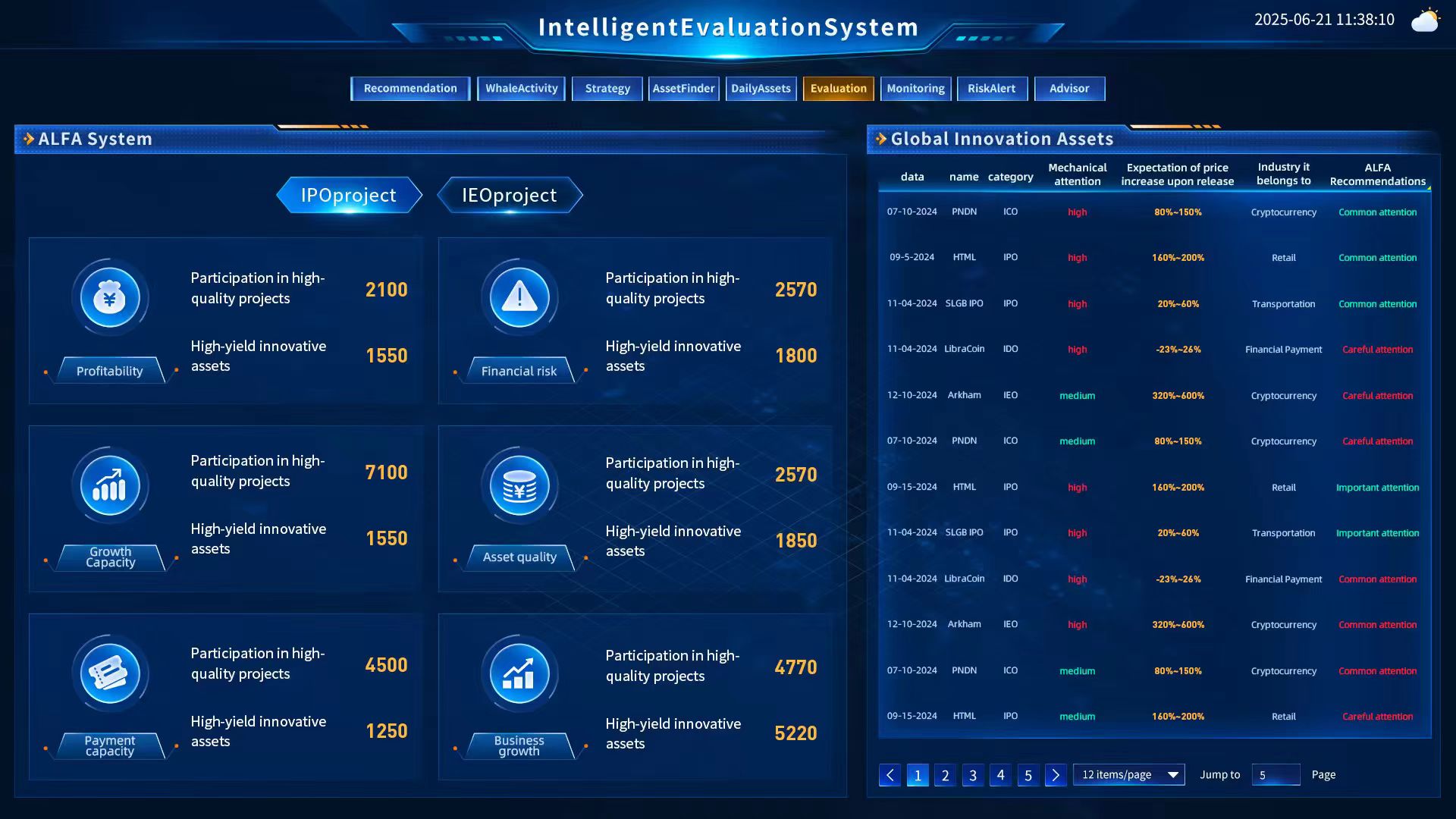
Feature 6: Intelligent Evaluation System – Understanding Multi Asset Markets Through a Unified Framework
Content Overview:
In modern investing, multi asset allocation has become the norm. Investors often need to understand the movements and relationships across several asset classes at the same time, including equities, bonds, commodities, forex exchange, and crypto assets.
However, traditional investment tools often operate independently. Equity analysis tools focus only on stocks, while crypto platforms focus only on digital assets. As a result, there is often no unified framework that helps investors understand how these assets interact with each other.
The Intelligent Evaluation System addresses this challenge by building a unified cross asset evaluation framework. It applies a consistent analytical logic to answer the questions investors care about most.
For example, is the current market environment trending, range bound, or high risk? Is market volatility expanding or contracting? How are correlations between different assets changing? Which assets are leading and which are lagging?
Through accurate identification of market conditions, real time monitoring of volatility dynamics, analysis of cross asset correlations, and evaluation of relative asset strength, the system provides investors with a comprehensive view of the market.
Today, multi asset allocation has become a central approach in investment strategy. Investors increasingly need to monitor equities, bonds, commodities, forex exchange, and crypto assets while also understanding how these markets influence one another.
Traditional analytical tools, however, often remain isolated within individual asset classes and therefore struggle to provide a broad market perspective.
The unified framework of the Intelligent Evaluation System fills this gap by offering integrated cross market and cross asset analysis.
This enables investors to gain deeper insight into complex market conditions and make more informed and precise investment decisions.
Core Purpose:
The Intelligent Evaluation System provides investors with clear and comprehensive market insight through its original cross asset unified evaluation framework. It is designed to answer the most important questions investors face in a precise and practical way.
The system can accurately identify the current market environment. Whether the market is in a trending phase, a range bound phase, or a high risk phase, the system offers clear guidance that helps investors select the appropriate strategy.
Through dynamic monitoring of market volatility, the system can determine whether volatility is expanding or contracting. This allows investors to recognize changes in the level of market risk and adjust their level of participation accordingly.
The system also conducts in depth analysis of the relationships between different asset classes. By evaluating high correlation, low correlation, and inverse correlation, it helps investors optimize asset allocation and improve the effectiveness of risk diversification.
In addition, the system ranks the relative strength of assets. This reveals which assets are leading and may indicate upward market potential, and which assets are lagging and may signal a possible rebound opportunity or a weakening trend.
The core value of this framework is that it provides investors with a comprehensive view of the market. Investors can quickly understand the overall market environment as well as the relative positioning of different assets.
By combining analysis of asset correlation and relative strength, investors can refine their asset allocation and choose strategies that best match the current market conditions. This may include following market trends, capturing opportunities in range bound conditions, or adopting defensive positioning.
When market volatility expands or when unusual changes in asset correlations occur, the system can also provide timely risk alerts. This helps investors prepare and respond in advance. In the era of multi asset allocation, the Intelligent Evaluation System offers investors a powerful analytical tool that significantly improves the efficiency and accuracy of investment decisions.
Key Advantages:
The strength of the Intelligent Evaluation System lies in its unified structure, multi dimensional analysis, dynamic monitoring, and strong practical value.
By establishing a consistent analytical framework, the system evaluates multiple asset classes using the same logic, which avoids the fragmented approach often seen in traditional analytical tools.
At the same time, the system examines the market from several perspectives, including market conditions, volatility patterns, cross asset relationships, and relative asset strength. This approach provides a complete and up to date view of the market and ensures that evaluation results remain aligned with changing market conditions.
Most importantly, the system delivers clear assessments of market environments and transparent rankings of asset strength. These insights provide investors with precise guidance for asset allocation and strategy selection, making the investment process more systematic and efficient.